

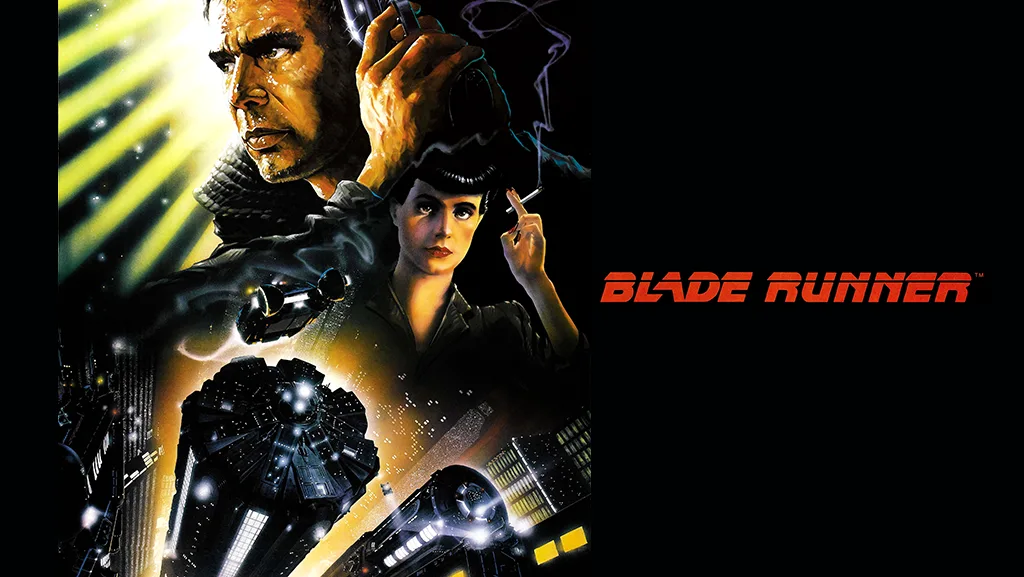
1. Metadata & Quick Info
- Quick Stats:
- Director: Ridley Scott
- Genre: Neo-noir / Sci-Fi
- Runtime: 117 minutes (Theatrical) / 110 minutes (Director’s Cut) / 117 minutes (Final Cut)
- Lead Cast: Harrison Ford, Rutger Hauer, Sean Young
- Score: Vangelis
- Rating: 8/10

2. Introduction: The Cult of Blade Runner I never thought of myself as a Cyberpunk fan. These high-tech dystopian themes couldn’t amaze me in any way, and usually, I would just skip any reference to these settings. Even though, over the years, I have seen some great content referring to the cyberpunk aesthetic (Judge Dredd, Altered Carbon), I would still insist that this specific style isn’t my cup of tea.
The thing that changed my view on cyberpunk settings was Cyberpunk 2077. I fell in love with the game, I invested in its world, and I kept wanting more. In a phase like that, I started looking for anything that could satisfy my thirst for more cyberpunk-ish stories. Of course, I had already heard about Blade Runner, but now I had a reason to watch it.
In the end, I don’t know if I got what I was expecting. Blade Runner is described by many as a neon-noir masterpiece, a detective story in a fascinating cyberpunk world. Was it true? In my opinion, the film has many flaws, mostly in its scenario. On the other hand, it excels in many other categories. So, is the scale leaning more toward the positive or negative? Let’s see.
- The Legacy: I was surprised to find out that Blade Runner was considered a failure in its time. Maybe it had something to do with the slow pacing or the competition at the box office, since some exceptional movies were released that year (E.T., The Thing, etc.). However, time did it justice, and after many years, the film is a definitive cult classic.
- The Aesthetic: Blade Runner did something unique. It showed us a world that we had never seen before. Even now, watching the movie makes me look with awe at the setting, the details, and the scenery Ridley Scott imagined. And to be honest, I realized where all these influences we see in modern pop culture came from.

3. The Premise: 2019 Through a 1982 Lens
- The Setup: The year is 2019 (yes, I know; 2019 seemed very distant at the time). The movie follows Rick Deckard, a former Blade Runner whose job was to “retire” Replicants. Designed by the Tyrell Corporation, Replicants are androids that cannot be distinguished from a normal human. They are manufactured for certain jobs, usually sent to other planets, and have a specific expiration date. Deckard’s assignment is to find four Replicants that have escaped and are illegally on Earth and terminate them.
- The World: The movie takes place in a futuristic Los Angeles. The noir aesthetic is there: dark places, overpopulated streets under constant rain, and a filthy essence that grips you easily. I don’t know what the budget was, but I think that the production is great. The design of the city and the details are impressive, giving you the vibe of what a dystopian LA would look like.
- The Inciting Incident: The theme of the movie is something that nowadays we have seen many times. Replicants start to develop senses and want to live longer. That’s why they escape: to search for their creator and tell him to give them more life. Moreover, they see humans as a threat and are hiding to avoid them. However, even if their cause is not bad, the Replicants in the movie are portrayed as frightening beings that will do anything to succeed.
4. Performance: The Hunter and the Hunted
- Deckard’s Weariness: I want to compare Harrison Ford’s performance to Han Solo. I think he is doing a great job acting, providing a different character from the one we are used to seeing him play. He is more serious, darker, and the tone in his voice is very fitting. I have to confess, though, that the narration is not very good. It feels very forced.
- Roy Batty (Rutger Hauer): The main antagonist is played by Rutger Hauer, and I have to say that he is the perfect choice for the role. Poetic at times and intimidating, Hauer brings to life an iconic villain I will remember forever. Bonus for me: I got excited when I realized he was the main character in Observer, a cyberpunk detective game that I really liked. I saw a connection to the legacy there.
- The Replicants: Of course, I have to mention Sean Young as Rachael and Daryl Hannah as Pris. Both actresses deliver great performances as Replicants—Young, with the drama of a person who tries to accept that she is artificial, and Hannah as the main villain’s right-hand and companion. I have to say that both actresses are quite undervalued in my eyes, and they should have had bigger careers. In Blade Runner, even though their roles are limited, they leave their mark on the movie.
In general, the casting for the film is magnificent. All the actors are more than suitable for the roles, and their chemistry is undeniable. Each character is wonderfully portrayed, along with the costumes and all the little details Ridley Scott added to them. I couldn’t find a more fitting cast for the movie, really. It all blends greatly.

5. Technical Mastery: World-Building Without CGI
- Visual Design: Even if the movie didn’t come close to how 2019 was in real life, Blade Runner’s visual design is exquisite. The buildings, the vehicles, and the items the characters use are unique. For this fantastic result, which at the time people could only imagine from books, we have to thank Syd Mead. He is known as “the artist who illustrates the future,” and his work is famous in many other big-budget films. He truly inspired a generation of future artists.
- Practical Effects: The CGI in the movie is very limited. Most of the settings are a combination of practical effects along with paintings and drawings, a technique that was very common at the time. What blew my mind was the little details you can see in every background. In every room, on every road, the rain, the illumination, even on the characters’ outfits, there are small pieces of perfection. This is something that is lacking in recent movies, since they all depend on CGI to create worlds and action sequences.
- Vangelis’ Score: The world of Blade Runner wouldn’t be the same without Vangelis’ heavy soundtrack. Electronic synthesized notes and dark, uneven themes set the tone in every scene, delivering that mysterious, noir atmosphere that the movie is well-known for.

6. Thematic Analysis: More Human Than Human
- Memory and Identity: In the movie, some Replicants have fake photographs and memories that aren’t real. They have been implanted with a fake life to be controlled and act more like humans. So, I guess one of the themes of the movie is that our memories and our past make us who we are, and without them, we would be mindless “robots.”
- The Creator vs. The Created: The illegal Replicants in the movie search for Tyrell, their creator, to ask him for more “life,” because they have an expiration date. When they finally go to him, Tyrell says that there is no solution to this problem, and the Replicants will “die” no matter what—just like humans. The final verdict is to live your life with what you have on hand, as the future is uncertain.
- The Great Question: There are some theories that Deckard was a Replicant as well, and I wondered about it myself a couple of times throughout the movie. I believe these theories exist due to some parallels we see in the film between Deckard and the Replicants, like the photos of his family and the feelings he was starting to develop.
However, I don’t think that Deckard was artificial because of two things. First, Tyrell said that Rachael was a unique new model that didn’t have an expiration date. So, she was the first one. And second, all Replicants had superhuman strength, something that Deckard didn’t have. In all his fights, he was clearly overpowered by the androids.

7. Pros & Cons
- Pros: The things that I liked in Blade Runner are truly many. Let’s see the pros:
- Ridley Scott brings his A-game. Fantastic directing, scenes, and camera movements. Everything is top-tier.
- The casting of the movie is one of the best I have seen, and the acting is fantastic.
- The practical settings, along with the score, give an unparalleled atmosphere.
- A detective noir story told in a cyberpunk universe in the best way.
- Nice themes that leave space for questioning, theories, and conversations.
- Cons: Unfortunately, there are some negatives that I cannot skip and that I was thinking about while watching the movie:
- The pace is quite slow, even though I think it adds to the mystery.
- Some things had no logic at all—and I am talking about the behavior of the Replicants. They could have killed Deckard so many times, and they still didn’t. I can’t get past this thing easily. Especially when fighting Pris: the whole thing of how she ran away from him just to give him the time to shoot her is just stupid.
- The narration from Harrison Ford looks very procedural and forced.

8. Final Verdict: A Timeless Vision
- Who is this for? As I said before, Blade Runner is a classic. A detective noir in a cyberpunk world designed in detail. It has the quality that unfortunately doesn’t exist in modern movies, and you will appreciate every moment of it. If you can cope with the slow pacing and some flaws in the scenario, give it a try. It’s really worth it for the fantastic atmosphere, the stellar acting, and all the philosophical themes the movie presents.
The “Best Version” Recommendation: There are various versions throughout the internet. The one thing I can say for sure is that I watched the version that is available on Prime Video. I don’t know which it is, but it has the same length as the “Final Cut” version. For the version I have watched, my rating is a solid 8. Surely a sci-fi classic!